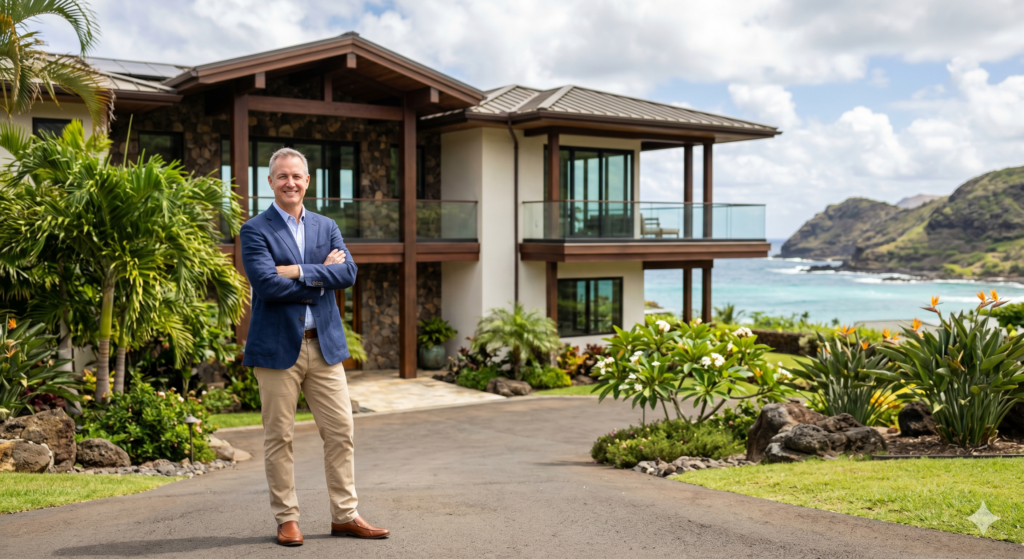
Hawaii’s rental market is one of the strongest in the country — driven by year-round tourism, limited housing supply, a large active duty military population, and consistent demand from both long-term residents and short-term visitors. For real estate investors, that demand creates real opportunity. The challenge has always been qualifying for financing when your income looks unconventional on paper.
DSCR loans — and the broader category of Non-QM investor programs — solve that problem by shifting the qualifying conversation away from your personal tax returns and toward what actually matters: what the property earns.
This guide covers how DSCR and Non-QM investor financing works in Hawaii, who it’s right for, and the full range of programs available through C2 Hawaii — including high-balance portfolio programs for investors working at the $5M, $10M, and $30M level.
What Is a DSCR Loan?
DSCR stands for Debt Service Coverage Ratio. It’s a simple calculation: monthly rental income divided by monthly debt obligation (principal, interest, taxes, insurance, and HOA if applicable).
- DSCR above 1.0 — the property generates more income than its debt costs. Many programs require at least 1.0 to 1.25, but we offer programs that have greater flexibility.
- DSCR of exactly 1.0 — the property breaks even.
- DSCR below 1.0 — the property doesn’t cover its own debt. Some lenders will still consider these scenarios depending on the overall deal strength.
What makes DSCR loans powerful is what they don’t require: no W-2s, no tax returns, no employment verification, no personal debt-to-income calculation. The underwriter is evaluating the property, not your personal financial profile.
Who DSCR Loans Are Built For
DSCR financing is the right tool when any of these apply:
Self-employed investors with significant write-offs. If your tax returns show low net income because you run everything through your business, a conventional loan will undercount your real financial strength. DSCR bypasses that entirely.
Investors with multiple financed properties. Conventional loans cap you at 10 financed properties. DSCR has no such limit — each property qualifies on its own cash flow.
Investors who want to close in an LLC. DSCR programs support entity closings, which keeps the loan off your personal credit report and provides liability separation. This is the standard structure for serious investors building a portfolio.
Out-of-state or foreign investors. Hawaii’s rental yields attract mainland and international buyers. DSCR programs are available to non-resident investors, and some programs extend to foreign nationals who don’t have U.S. income or credit history.
First-time investors. Most DSCR programs allow first-time investors — you don’t need a track record to qualify.
Short-Term Rental Income in Hawaii: What You Need to Know
Hawaii is one of the top short-term rental markets in the country — Waikiki, Kaanapali, Poipu, Kailua-Kona, and Princeville all command premium nightly rates that can significantly outperform long-term rental income on a monthly basis. DSCR lenders generally accept short-term rental income qualification through one of two methods:
Lease agreement / long-term rent: If the property has an established tenant, the lease rate is used to calculate DSCR.
Market rent / Airbnb income: For short-term rentals without a lease, lenders typically use an appraiser-generated market rent estimate (from the appraisal report) or documented Airbnb/VRBO income history. The methodology varies by lender — we match you with programs that work for your specific property and income documentation.
Important caveat for Hawaii investors: Short-term rental regulations vary significantly by county and zone here. Some areas have strict permit requirements or outright restrictions on vacation rentals. Before acquiring an investment property in Hawaii specifically for short-term rental use, verify local compliance. We can discuss the financing side; you’ll want a local real estate attorney or agent for the regulatory side.
DSCR Program Guidelines (General)
Program specifics vary by lender — as a broker, C2 Hawaii has access to multiple DSCR programs and matches you with the best fit for your scenario. General parameters across our programs:
Loan Amounts: Typically $300,000 to $3M+ on standard DSCR programs. See the jumbo/portfolio section below for higher amounts.
Down Payment: Generally 20-25% for purchase. Some programs allow less with stronger DSCR ratios.
Credit Score: Minimum 620-640 depending on program. Better terms available at 700+.
DSCR Ratio: Most programs require 1.0 minimum. Some programs consider sub-1.0 ratios with compensating factors.
Property Types: Single-family, 2-4 units, multi-family, condos (subject to project eligibility), short-term rentals, condotels on select programs.
Loan Purpose: Purchase, rate/term refinance, cash-out refinance.
Entity Closing: LLC and partnership closings supported — does not report on personal credit.
Interest-Only Options: Available on select programs — reduces monthly obligation and improves cash flow, particularly useful for properties with seasonal income patterns.
Cash-Out: Available up to 70-75% LTV on refinances with no seasoning requirements on some programs.
No limit on number of financed properties.
Jumbo & High-Balance Non-QM Investor Programs
Standard DSCR programs typically cap around $3M. Hawaii’s luxury and commercial investment market regularly exceeds that — and this is where our high-balance Non-QM portfolio programs come in.
Through our lender network, we have access to programs specifically built for large-balance investor transactions, including programs with loan amounts up to $30 million and features that simply don’t exist in conventional or standard Non-QM lending.
Key features of our high-balance investor programs:
Large Loan Amounts — Up to $30M No hard ceiling on cash-out amounts. For investors acquiring or refinancing luxury residential, multi-family, or commercial properties in Hawaii’s high-value markets — Kahala, Kailua, Wailea, Lanikai, Diamond Head — this is the tier that applies.
Asset Depletion Significant liquid assets can be converted to qualifying income without liquidating them. Ideal for high-net-worth borrowers with substantial investment portfolios who don’t draw a traditional salary.
Cross-Collateralization Use equity across multiple properties to strengthen your loan position or increase proceeds — particularly useful for investors with a portfolio spread across multiple islands.
Bridge-to-Sale Need to access equity in a property that’s currently listed for sale? These programs allow refinancing of properties actively on the market — a scenario most conventional lenders won’t touch.
Omit Departing Residence Debt Moving up or repositioning a property? In qualifying scenarios, the debt on a departing residence can be excluded from your qualifying ratios, making it significantly easier to close on the next acquisition before the current property sells.
Privacy Mortgage For high-profile buyers who prefer their personal information not appear in public property records. This is a meaningful option for executives, athletes, entertainers, and other high-net-worth individuals purchasing in Hawaii.
Pledged Assets Stocks, mutual funds, and other investment assets can be pledged as collateral to qualify without liquidating — keeping your investment portfolio intact while securing the real estate loan.
1031 Reverse Exchange Buy the replacement property before selling the relinquished property. This is a complex but powerful structure for investors doing 1031 exchanges who need to close on the new acquisition first — particularly relevant in Hawaii’s market where desirable properties don’t wait.
Interest-Only Options Available on owner-occupied (primary and second home) and non-owner-occupied transactions, improving cash flow management on high-balance loans.
How DSCR Fits Into a Broader Investment Strategy
DSCR is often one piece of a larger financing approach for active investors. A few scenarios where the programs above work together:
The Portfolio Builder: An investor closes properties 1-3 on DSCR loans in their LLC. Once equity builds, they do a cash-out DSCR refinance on early properties and use those proceeds as down payments on the next acquisitions.
The Distressed Property in Hawaii: Buy a distressed property using hard money or a bridge loan, renovate it, stabilize the rental income, then refinance into a long-term DSCR loan. The DSCR refi replaces the expensive short-term money with a real loan based on what the property now earns.
The High-Net-Worth Buyer: A wealthy buyer without traditional W-2 income wants to acquire a $5M Maui property. Asset depletion converts their investment portfolio to qualifying income. Or they pledge assets without liquidating. Or they go privacy mortgage to keep the transaction off public records. The point is — there’s more than one path.
The Move-Up Investor: An investor wants to acquire a new property before their current one sells. Omit departing residence debt removes the existing obligation from their qualifying ratios, making the new purchase possible without a sale contingency.
DSCR vs. Bank Statement vs. Other Non-QM Programs
DSCR isn’t the only tool for investors and self-employed borrowers. Here’s how the main programs compare:
DSCR Loan — qualifies on rental income from the subject investment property. Best for: investors whose property generates strong rental income.
Bank Statement Loan — qualifies on 12 months of personal or business bank statement deposits as income. Best for: self-employed borrowers buying a primary or second home, or investors whose personal income supports the deal but tax returns don’t reflect it. More on Bank Statement Loans
Asset-Based Loan — qualifies based on total liquid assets rather than income. Best for: high-net-worth borrowers with significant savings or investment portfolios and no traditional income.
No Income Loan — no income documentation of any kind. Best for: borrowers with adequate assets and down payment but no verifiable income source.
Most investors don’t live entirely in one bucket. A borrower might combine bank statement income with a pledged asset structure, or use DSCR for their investment portfolio while using a bank statement loan on their primary residence. That’s where working with a broker who knows all the programs becomes the actual value.
Why Work With C2 Hawaii for DSCR & Non-QM Financing
Direct lenders — even good ones — have one set of guidelines. When your deal doesn’t fit their box, the answer is no.
C2 Hawaii operates as a broker with access to a broad network of wholesale Non-QM and portfolio lenders. That means:
- We match your specific scenario — loan amount, property type, income documentation, entity structure — to the program that’s the best fit
- We can access programs up to $30M+ that most local brokers and retail lenders don’t offer
- We’ve been structuring Non-QM loans in Hawaii since 2014, across all islands
- Your loan is handled by our team from start to finish
For investors working at the high end of the market — $2M, $5M, $10M and above — having access to the right programs matters as much as the rate.
Frequently Asked Questions
Can I close a DSCR loan in an LLC? Yes. Most DSCR programs support LLC and partnership closings. This keeps the loan off your personal credit report and provides asset protection.
Does the property need to be currently rented? Not always. Many programs use market rent from the appraisal report to calculate DSCR on a property that isn’t yet tenanted.
Can I use projected Airbnb income to qualify? Depends on the program. Some lenders use documented short-term rental history; others use market rent from the appraiser. We’ll identify which approach works best for your property.
Is there a limit on how many DSCR loans I can have? No — unlike conventional loans, there’s no cap on the number of properties financed under DSCR programs.
What’s the minimum credit score? Generally 620-640 on standard programs. Higher balances and better terms are available at 680+.
Can foreign nationals use DSCR loans to invest in Hawaii? Yes, on select programs. See also our Foreign National Loan page for programs specifically built for international buyers.
What’s the difference between a DSCR loan and a hard money loan? Hard money is short-term, typically 6-24 months, and designed for speed and flexibility over a brief period. DSCR is a long-term loan — 30-year fixed or ARM — designed as a permanent hold structure. Many investors use hard money to acquire or renovate, then refinance into DSCR once the property is stabilized.
Ready to Talk Through Your Deal?
Whether you’re buying your first investment property in Hawaii, refinancing a portfolio, or working on a complex high-balance transaction — let’s start with a conversation.
Call (808) 369-1700 | Available 24/7
C2 Financial Corporation | Hawaii Branch NMLS #1244222 | Licensed Hawaii Mortgage Broker. Non-QM loan products are not government-backed loans. All loans subject to borrower and property qualification. Rates and terms subject to change. Program availability varies by lender.